 pedia
Last updated: 30 August 2026
In brief: Rose oil (INCI: Rosa Damascena Flower Oil) is a cosmetic fragrance ingredient rich in citronellol, geraniol and nerol, and is counted among the most valuable essential oils on world markets. Together with rose water (INCI: Rosa Damascena Flower Water), the water phase of the distillation, it has a centuries-old history of cosmetic use; it is favoured in soap making for its rich, balsamic-floral scent profile.
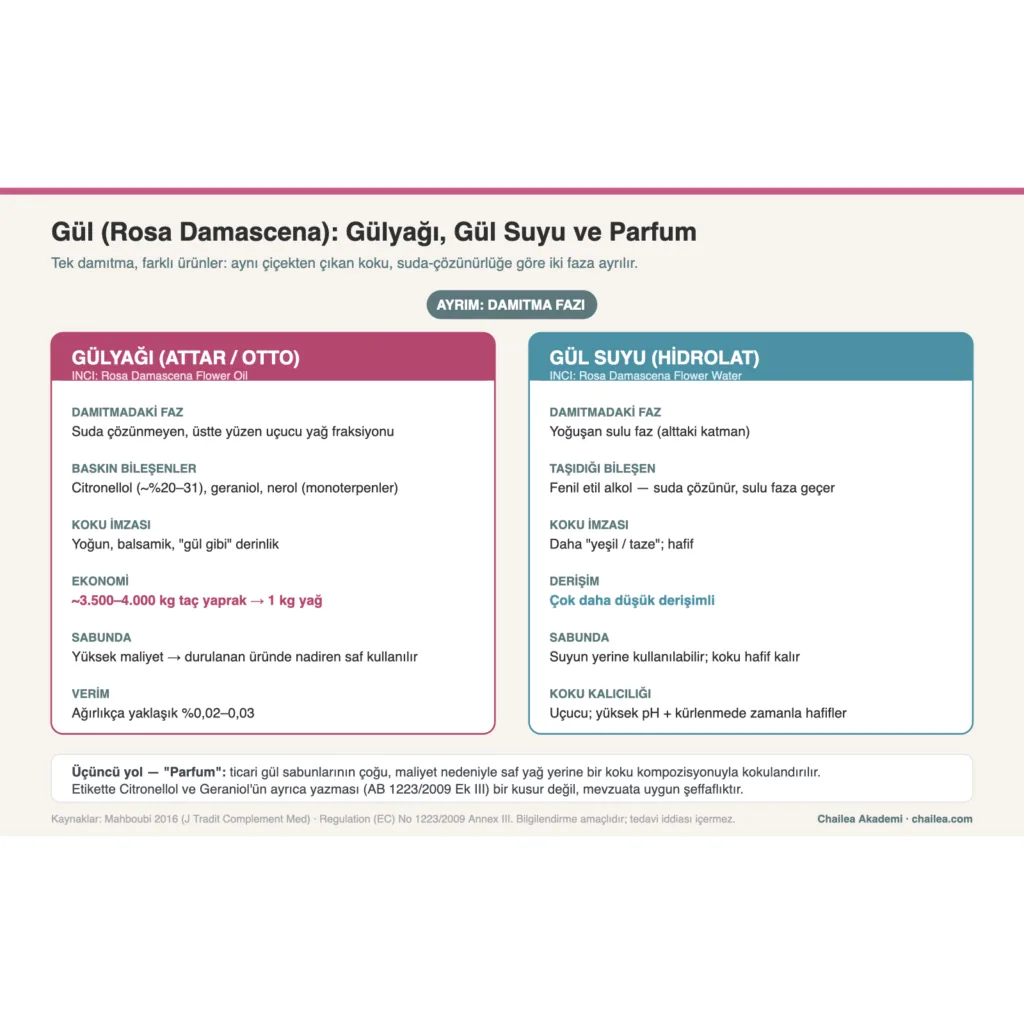
The rose is one of the oldest plants cultivated for its scent. The species at the centre of cosmetic history is Rosa × damascena Mill. (family Rosaceae), the Damask rose, known in Anatolia as the oil rose. The “×” sign in the scientific name shows that the plant is a cultivated hybrid: the Damask rose did not arise on its own in nature, but was shaped by human hands, selected for its fragrance. Rose oil and rose water, obtained by distilling the petals, are used across a wide range of cosmetic applications, from perfumery to soap making; the main components of the oil are citronellol and geraniol (Mahboubi, 2016). This monograph treats the rose as a cosmetic ingredient and makes no claim of treatment or healing.
This article is not a product promotion. It is a cosmetic ingredient monograph; it is not a product or treatment recommendation.
Botanical source and history
Rosa × damascena is a thorny, perennial shrub 1 to 2 metres tall that bears pink, double, intensely fragrant flowers. It takes its name from the city of Damascus; in Iran it is called “Gole Mohammadi” and lies at the centre of the region’s rose water tradition (Boskabady et al., 2011). The two major centres of scented rose cultivation today are the Kazanlak valley in Bulgaria and the Lake District of Türkiye: Isparta and its surroundings are known as the “City of Roses” and are the heart of Türkiye’s rose oil production. The 2024 edition of ISO 9842, the international quality standard for rose oil, also defines its scope by roses grown in Türkiye, Morocco and Bulgaria, a detail that reflects the global weight of Isparta’s rose cultivation.
The harvest season falls within a few weeks between May and June. To limit the loss of volatile components, the flowers are traditionally picked by hand, one by one, early in the morning, and distilled the same day. The yield of oil from the rose is extremely low; combined with the lack of a full natural or synthetic substitute, this low yield places rose oil among the most expensive essential oils on world markets.
Distillation: rose oil, rose water and absolute
Fresh petals are processed by water distillation, producing two products: distilled rose oil (rose otto; INCI: Rosa Damascena Flower Oil) and rose water (INCI: Rosa Damascena Flower Water), the water phase of the distillation. In traditional practice, part of the scent components that pass into the water phase is recovered by redistilling the first distillation water (cohobation).
The third form, rose absolute, is obtained not by distillation but by solvent extraction: a waxy “concrete” is first extracted from the petals, and the absolute is then extracted from it with alcohol. The composition of the absolute differs markedly from that of the distilled oil; in an analysis of Turkish origin, the main component of the absolute was measured at 78.4% phenylethyl alcohol (Ulusoy et al., 2009). Extraction products also appear on cosmetic labels as Rosa Damascena Flower Extract. Knowing that the three INCI names (Oil / Water / Extract) correspond to three different raw materials is a small but practical part of ingredient list literacy.
Chemical profile and international standard
Rose oil is a complex mixture of around 300 components, and its composition varies with geographical origin, cultivar, harvest stage and distillation conditions; the ISO 9842 standard defines its quality parameters. In a study comparing different growing regions, the ranges of the main components were reported as: citronellol 15.9–35.3%, geraniol 8.3–30.2%, nerol 4.0–9.6%, nonadecane 4.5–16.0%, heneicosane 2.6–7.9% and linalool 0.7–2.8% (Verma et al., 2011).
| Component | Typical range | Note |
|---|---|---|
| Citronellol | 15.9–35.3% | Dominant component of the distilled oil; a fragrance allergen that must be declared on labels |
| Geraniol | 8.3–30.2% | A fragrance allergen that must be declared on labels |
| Nerol | 4.0–9.6% | — |
| Nonadecane | 4.5–16.0% | — |
| Heneicosane | 2.6–7.9% | — |
| Linalool | 0.7–2.8% | — |
Citronellol (16–35%)
Citronellol, the largest component of rose oil, is a monoterpene alcohol and the main carrier of the fresh, petal-like character of the rose scent. Safety data for citronellol as a cosmetic fragrance raw material are compiled in RIFM’s comprehensive literature reviews (Lapczynski et al., 2008a). Citronellol also appears on the EU Cosmetics Regulation’s list of fragrance components that must be separately declared on labels (see the “Safety profile” section below).
Geraniol and nerol
Geraniol and its cis-isomer nerol form a pair of monoterpene alcohols that give the rose scent its sweet, floral-green depth. A detailed fragrance raw material review of geraniol prepared by RIFM is also available (Lapczynski et al., 2008b). The balance between citronellol and geraniol is one of the main parameters monitored in the quality assessment of distilled rose oil.
Phenylethyl alcohol
Phenylethyl alcohol, one of the signature molecules of fresh rose scent, is partly soluble in water and therefore largely passes into the water phase during distillation. The result is an elegant division of chemistry: this component, which remains at a low level in distilled rose oil, makes up 66–80% of the volatile fraction of rose water, where it is by far the main component (Verma et al., 2011), and it is the dominant component of the solvent-extracted absolute at over 78% (Ulusoy et al., 2009). The “fresh rose” character of rose water owes much to this molecule.
Stearoptenes and trace scent components
The stearopten fraction, made up of long-chain hydrocarbons such as nonadecane and heneicosane, is the reason rose oil partly solidifies in a cool environment; this odourless waxy phase is a characteristic physical signature of the oil. The depth of the scent, however, comes from trace components: β-damascenone and rose oxide, although present in very low proportions, are molecules whose contribution to the scent profile is particularly emphasised in the literature. β-damascenone has been shown to be stored in rose petals in a glycoside-bound precursor form (Straubinger et al., 1997) — the flower packs and stores its scent with sugar, one of the most poetic details of rose chemistry.
In vitro research
In a study of Turkish origin, the composition and laboratory activity of rose oil, rose water and absolute were compared; the absolute and the essential oil were reported to show activity under in vitro conditions against various strains, including Escherichia coli and Staphylococcus aureus, and high levels of α-tocopherol and β-carotene were measured in the absolute (Ulusoy et al., 2009). Comprehensive reviews compiling the traditional uses of the rose and its pharmacology literature are also available (Boskabady et al., 2011; Mahboubi, 2016). These findings relate to laboratory conditions and the context of human medicinal products; they lie outside the scope of this cosmetic monograph and do not constitute any product effect claim.
Safety profile
General assessment
Cosmetic ingredients derived from Rosa damascena (ten named forms including oil, water and extract) are registered in cosmetics mainly for fragrance and skin-conditioning functions. The published safety assessment of the Cosmetic Ingredient Review (CIR) programme does not cover this species, but rather ingredients derived from dog rose (Rosa canina) (2022). Safety data for the main components, citronellol and geraniol, as fragrance raw materials are compiled in RIFM reviews (Lapczynski et al., 2008a; 2008b).
Allergen declaration and storage
Citronellol and geraniol are among the fragrance components that must be separately declared on labels under the EU Cosmetics Regulation (EC/1223/2009); when they exceed specific thresholds (0.001% in leave-on products and 0.01% in rinse-off products), they must be listed separately in the INCI list. Because sensitisation to scent alcohols is largely linked in the literature to oxidation products, storing rose oil in a dark, cool place in a tightly closed container matters for both scent quality and safety.
Methyl eugenol and IFRA limits
Methyl eugenol, which may occur at trace levels in rose oil, is one of the components subject to a usage limit under IFRA standards; for this reason, the proportion of rose oil in a finished product is determined within the framework of IFRA guidelines by product category. Responsible formulation requires staying within these limits.
Rose in soap making
Forms of use and proportions
The value of rose oil has given rise to a distinctive tradition in soap craft: the character of the rose is built not from a single raw material but in layers. Distilled oil or absolute is added at very low rates by the cold process at trace stage; rose water can be used in the water phase of the recipe; and pink clay and dried rose petals give the colour and texture the flower’s visual signature. Chailea’s natural rose soap is a cold-process interpretation of this layered tradition from Çayeli, Rize.
Scent profile, longevity and blends
Rose gives soap a rich, balsamic-floral and lightly powdery scent profile; in the alkaline environment, the fresh floral notes soften and evolve into a rounder character. In a blend, rose acts as a “heart note”: base notes such as sandalwood and patchouli support its longevity; the clean floral profile of lavender oil creates classic floral blends with a soft cohesion; and green-camphoraceous Mediterranean notes such as rosemary oil create a fresh contrast that balances the sweetness. In rich care soaps formulated for dry and normal skin types, rose is one of the most preferred scent characters.
Frequently asked questions
What is rose oil?
Rose oil is an essential oil obtained by water distillation from the petals of Rosa × damascena flowers (INCI: Rosa Damascena Flower Oil). Its main components are citronellol (16–35%), geraniol and nerol; because of its low yield it is counted among the most valuable essential oils in the world.
What is the difference between rose oil and rose absolute?
Rose oil is obtained by water distillation, while the absolute is obtained by solvent extraction (from the concrete). Their compositions differ: in the distilled oil citronellol and geraniol are dominant, while in the absolute phenylethyl alcohol is the main component at over 78%. In perfumery the absolute is used more, while in soap and general cosmetics the distilled oil is more common.
What is rose water (hydrosol)?
Rose water is the water phase of rose oil distillation (INCI: Rosa Damascena Flower Water). The main component of its volatile fraction is phenylethyl alcohol (66–80%); this molecule carries the fresh rose scent. In cosmetics it can be used as a component in its own right, and in soap making it can be used in the water phase of the recipe.
Why is the rose of Isparta famous?
Isparta and the surrounding Lake District are the centre of Türkiye’s rose oil production and are known as the “City of Roses”. The international quality standard for rose oil, ISO 9842 (2024 edition), defines its scope by roses grown in Türkiye, Morocco and Bulgaria; at the May–June harvest, flowers are picked by hand in the early morning.
Chailea products containing this ingredient
- Natural Rose Soap 100 g
References
- Boskabady MH, Shafei MN, Saberi Z, Amini S. Pharmacological effects of Rosa damascena. Iranian Journal of Basic Medical Sciences, 2011; 14(4):295-307. PMID: 23493250. PubMed. (Pharmacology review; medicinal use lies outside the scope of this cosmetic monograph.)
- Mahboubi M. Rosa damascena as holy ancient herb with novel applications. Journal of Traditional and Complementary Medicine, 2016; 6(1):10-16. PMID: 26870673. PubMed. (Ethnobotany/phytochemistry review; the medicinal context is out of scope.)
- Ulusoy S, Boşgelmez-Tınaz G, Seçilmiş-Canbay H. Tocopherol, carotene, phenolic contents and antibacterial properties of rose essential oil, hydrosol and absolute. Current Microbiology, 2009; 59(5):554-558. PMID: 19688375. PubMed.
- Verma RS, Padalia RC, Chauhan A, Singh A, Yadav AK. Volatile constituents of essential oil and rose water of damask rose (Rosa damascena Mill.) cultivars from North Indian hills. Natural Product Research, 2011; 25(17):1577-1584. PMID: 21711177. PubMed.
- Lapczynski A, Bhatia SP, Foxenberg RJ, Letizia CS, Api AM. Fragrance material review on geraniol. Food and Chemical Toxicology, 2008; 46 Suppl 11:S160-S170. PMID: 18640215. PubMed.
- Lapczynski A, Bhatia SP, Letizia CS, Api AM. Fragrance material review on l-citronellol. Food and Chemical Toxicology, 2008; 46 Suppl 11:S110-S113. PMID: 18640228. PubMed.
- Straubinger M, Knapp H, Oka N, Watanabe N, Winterhalter P. Isolation of a glucosidic beta-damascenone precursor from rose petals. Journal of Agricultural and Food Chemistry, 1997; 45(10):4053-4056. DOI: 10.1021/jf970278j.
ISO 9842:2024 — Essential oil of rose (Rosa × damascena Miller). · IFRA — Methyl Eugenol standard and fragrance raw material use guidelines. · CIR — Safety Assessment of Rosa canina-derived Ingredients as Used in Cosmetics. Int J Toxicol, 2022. doi:10.1177/10915818221080088 (rose hip derivatives; no separate CIR report exists for R. damascena). · EU Cosmetics Regulation (EC/1223/2009) — fragrance allergen labelling list.
Author: Oğuz Kağan Dereci, MSc Chemist (Chailea / ChaiNovi Sanayi Ticaret Ltd. Şti.)
This article was prepared within Chaileapedia — Chailea Academy. This content is for informational purposes and contains no treatment claims.
Chaileapedia — All Ingredient Monographs →