 pedia
1. Does Soap Lather in Hard Water? (The Question Capsule)
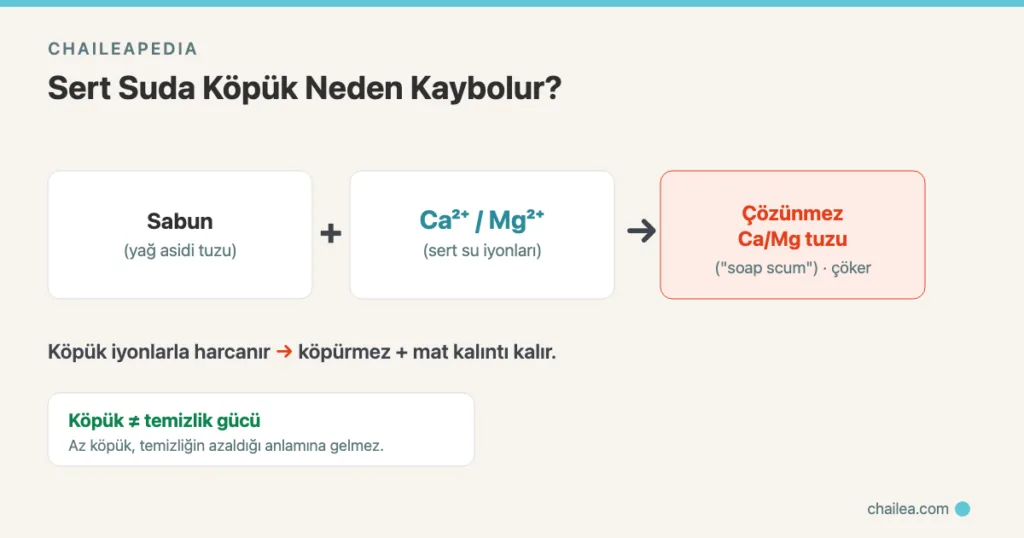
Does soap lather in hard water? It does, but noticeably less. In hard water, the calcium (Ca²⁺) and magnesium (Mg²⁺) ions combine with soap molecules to form insoluble calcium-magnesium soap (lime soap); the soap that should have produced foam is consumed by this precipitate. The result is little foam and a grey residue in the sink. Softening the water or increasing the amount of soap restores the foam.
Soap is, in essence, the sodium salt of a fatty acid, and when dissolved in water it produces foam thanks to its surface activity. However, when it encounters limy water, meaning water containing dissolved calcium (Ca²⁺) and magnesium (Mg²⁺) ions, these ions bind to the soap anion and form an insoluble precipitate. The result: foam is largely suppressed, and a sticky residue remains on the sink edge and on the skin.
The information-gain axis of this article rests on three pillars: (i) the chemistry of the insoluble salt formed by Ca²⁺/Mg²⁺ ions with soap anions, (ii) the role of lauric and myristic acid in foaming power, and (iii) the distinction between “foam ≠ cleaning power.” The narrative proceeds within a materials-science framework and contains no treatment claims.
2. What Is “Hardness”? The Invisible Ions in Water
The “hardness” of water is the concentration of its divalent cations, particularly calcium and magnesium ions. These ions dissolve out of rocks such as limestone (CaCO₃) and dolomite (CaMg(CO₃)₂) during the water’s journey through nature. Across much of Turkey, mains water is classified in the medium to high hardness range; this sits invisibly behind many everyday observations, from the white marks on kitchen utensils to the limescale layer in a kettle.
The key technical point to take from this is that the question “why doesn’t soap lather” often originates not in the soap itself but in the ionic charge of the water it contacts. The soap molecule works correctly; it is simply consumed in a different reaction before it can form foam.
3. The Core Chemistry: Soap + Hard Water = Calcium Soap
The chemical backbone of a solid soap bar is the sodium salt of a long-chain fatty acid. It is written in short as RCOONa, where RCOO⁻ is the anion of a saturated or unsaturated fatty acid with 12 to 18 carbons. When dissolved in water, it dissociates into its ions:
RCOONa (s) → RCOO⁻ (aq) + Na⁺ (aq)
In hard water, Ca²⁺ and Mg²⁺ ions are also present in the medium. These ions pair with two fatty acid anions to form an insoluble salt in water:
2 RCOO⁻ (aq) + Ca²⁺ (aq) → (RCOO)₂Ca (s) ↓
The product of this reaction is called “lime soap” (calcium soap) in the classical literature, and it is observed as the ring around the bathtub, the sticky mark at the sink edge, and the matte stain left on towels. Soontravanich et al. (2010), by quantifying the equilibrium solubility of long-chain fatty acid salts in such systems, establish the identity of soap scum at the level of primary sources. Weil, Pierce and Linfield (1976) elaborate on the physicochemical nature of the same precipitate under the heading “lime soap dispersion.” Graham and Sackman (1983) show that calcium soaps are markedly less soluble than free fatty acids in physical solubility measurements (this measurement is cited here solely for the solubility phenomenon).
The numerical skeleton becomes clear with the verified records from PubChem:
| Component | Condensed notation | Molecular weight (g/mol) | PubChem CID |
|---|---|---|---|
| Lauric acid | C₁₂H₂₄O₂ | 200.32 | 3893 |
| Myristic acid | C₁₄H₂₈O₂ | 228.37 | 11005 |
| Stearic acid | C₁₈H₃₆O₂ | 284.5 | 5281 |
| Calcium stearate | C₃₆H₇₀CaO₄ | 607.0 | 15324 |
Stoichiometrically, when two stearate anions (each releasing one proton to Ca²⁺) bind to one calcium ion, a unit of 2 × 284.5 − 2 × 1.008 + 40.08 ≈ 607.0 g/mol is formed; the PubChem record confirms this exactly at 607.0 g/mol. In short, every single calcium ion in the water removes two soap anions from the system before they have the chance to produce foam.
At this point the key link is this: the chemical profile of coconut oil is dominated by lauric acid, and palm kernel oil offers a similar short-to-medium chain profile. In formulation, the share of these two raw materials is decisive for the soap’s behavior in hard water and for its foam profile. For details, the monographs on the foam chemistry of coconut oil and on palm kernel oil and lauric acid sources can be consulted.
4. Where Does Foaming Power Come From? The Role of Lauric and Myristic Acid
The quantitative and qualitative character of foam depends markedly on the carbon chain length of the fatty acid. The systematic measurements of Mitrinova et al. (2013) on C12–C16 fatty acids show that lauric (C12) and myristic (C14) acids produce high and rapid foam, while longer-chain acids such as palmitic (C16) produce foam of lower volume but a more “creamy” consistency. Soodoo, Deonarine, James and Narine (2025), covering a broader chain range including stearic (C18), demonstrate that chain length determines not only foaming but also the critical micelle concentration, water demand and reaction kinetics together.
The combined reading of these two studies translates a practical wisdom long known to soapmakers into chemical language:
- Lauric + myristic-dominant formulations (e.g. with a high coconut / palm kernel ratio) → abundant, fast, bubbly foam.
- Palmitic + stearic-dominant formulations (e.g. olive oil, castor oil, tallow) → lower-volume, creamy, long-lasting foam.
- Mixed formulations → a middle band where foam volume and skin feel are balanced.
In formulation, this balance is a deliberate choice. A soap bar that is high in lauric acid alone continues to produce comparatively more foam in hard water, but it is not entirely exempt from calcium soap formation; the laurate anion too can form an insoluble salt with Ca²⁺ at the appropriate stoichiometry. Thus the principle “lots of coconut, no problem” is only partly true; if the ion concentration is high enough, foam can still be suppressed.
For the reasons why solid soap and liquid soap behave differently in this context, the article on the solid soap versus liquid soap debate can be read as a complementary piece.
5. The Critical Distinction: Foam ≠ Cleaning Power
Consumer intuition tends to equate abundant foam with “cleaning.” Surface chemistry does not support this equation. Cleaning is the emulsification of oil and dirt particles by the polar-nonpolar dual structure of the surfactant molecule and their removal from water. Foam, on the other hand, is a visual-tactile by-product formed when air is trapped in a surface-active liquid. The two physical events overlap but are not identical.
The practical consequence of this distinction becomes clear in the scene that arises in hard water. The cleansing anion of the soap bar binds to Ca²⁺ and Mg²⁺ ions before it has time to produce foam. The low foam observed shows not that the soap is “non-functional,” but that its anions have been depleted by taking on the ion-removal load. Synthetic industrial surfactants (SLES, betaines, etc.) are relatively resistant to hard water; classical cold-process soap, honestly, interacts with hardness. This is a chemistry that cold-process soap does not avoid but transparently explains.
Within the same framework, the glycerin retained in the soap contributes to the creaminess of the foam and to the moist feel of the skin; for details, the article on why glycerin is retained in natural soap can be read.
6. Practical Outcome: What Changes in Hard Water and How to Manage It?
The reality of hard water cannot be changed by chemistry; however, it can be mitigated through formulation, method of use and the physics of rinsing.
- The advantage of warm water. As temperature rises, the solubility of fatty acid salts and their Krafft behavior shift in a favorable direction; the dissolved fraction of soap increases and the residue decreases. This is the physical reason why lukewarm water feels “cleaner” in the bathroom than cold water.
- Thorough rinsing. Rinsing with plenty of running water removes dissolved soap anions that have not yet precipitated from the surface; there is less opportunity for ion-bound precipitate formation.
- Acidic rinsing physics. Low-pH solutions such as dilute vinegar (acetic acid) can convert the calcium soap precipitate (RCOO)₂Ca back into free fatty acid and water-soluble calcium salt. This is the known chemical route for dissolving mineral residue; within the scope of this article, it appears here only as a mechanistic explanation, not as an application recommendation.
- Formulation balance. Lauric/myristic-dominant bars can retain comparatively more foam in hard water; palmitic/stearic-dominant bars offer less foam but a creamier feel. Where a Chailea formulation sits between these two ends determines how its hard-water behavior should be read.
The final framework is this: the answer to “why soap does not lather” in most cases lies not in the quality of the soap but in the ionic charge of the water. Chemistry explains the observation honestly and leaves no room for exaggeration.
Frequently Asked Questions
Why does soap not lather, while shampoo lathers in the same water?
Modern shampoos generally contain synthetic surfactants such as sodium laureth sulfate (SLES); these molecules do not form insoluble salts with calcium/magnesium ions in hard water. Classical cold-process soap, on the other hand, is directly a fatty acid salt and interacts chemically with hardness.
Is the grey-white residue in the bathtub and sink harmful?
This residue is essentially the calcium and magnesium salt of long-chain fatty acids (Weil et al., 1976). It belongs to the same chemical family as calcium stearate, which is also known as a food additive. It is an aesthetic problem; by its chemical profile, it is a mineral precipitate that can be removed by surface cleaning.
Does less foam mean less clean?
No. From the standpoint of surface chemistry, cleaning arises from the emulsification of dirt; foam volume does not directly measure the quantity of this function. In hard water, low foam indicates not an insufficiency of the soap but that it has been depleted by ions.
Is soap with a high coconut oil content better in hard water?
Partly. A formulation rich in lauric and myristic acid increases the tendency to foam (Mitrinova et al., 2013; Soodoo et al., 2025). However, if the ion concentration is high enough, laurate too can form a calcium-insoluble salt; the difference is one of durability, not immunity.
References
- Soontravanich, S., Lopez, H. E., Scamehorn, J. F., Sabatini, D. A., & Scheuing, D. R. (2010). Dissolution Study of Salt of Long Chain Fatty Acids (Soap Scum) in Surfactant Solutions. Part I: Equilibrium Dissolution. Journal of Surfactants and Detergents, 13(4), 367–372. https://doi.org/10.1007/s11743-010-1208-5
- Soodoo, N., Deonarine, S., James, S. O., & Narine, S. S. (2025). Towards a Deeper Understanding of Simple Soaps: Influence of Fatty Acid Chain Length on Concentration and Function. Processes, 13(9), 2770. https://doi.org/10.3390/pr13092770
- Weil, J. K., Pierce, C. J., & Linfield, W. M. (1976). Soap-based detergent formulations: XX. The physical and chemical nature of lime soap dispersions. Journal of the American Oil Chemists’ Society, 53(12), 757–761. https://doi.org/10.1007/BF02635479
- Mitrinova, Z., Tcholakova, S., Golemanov, K., Denkov, N., Vethamuthu, M., & Ananthapadmanabhan, K. P. (2013). Surface and foam properties of SLES + CAPB + fatty acid mixtures: Effect of pH for C12–C16 acids. Colloids and Surfaces A: Physicochemical and Engineering Aspects, 438, 186–198. https://doi.org/10.1016/j.colsurfa.2012.12.011
- Graham, D. Y., & Sackman, J. W. (1983). Solubility of calcium soaps of long-chain fatty acids in simulated intestinal environment. Digestive Diseases and Sciences, 28(8), 733–736. https://doi.org/10.1007/BF01312564
- PubChem (NIH/NCBI) compound records: Lauric acid (CID 3893), Myristic acid (CID 11005), Stearic acid (CID 5281), Calcium stearate (CID 15324). https://pubchem.ncbi.nlm.nih.gov/