 pedia
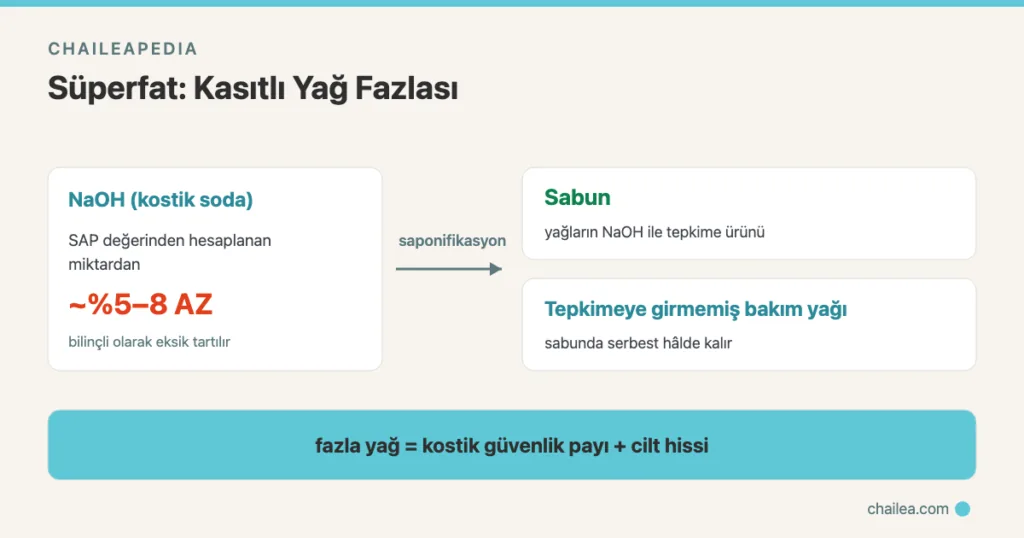
What Is Superfat? — Core Definition
The question “what is superfat” points to one of the most frequently confused concepts in cold process soapmaking. In soapmaking jargon the term also appears as “lye discount”, and it describes this: the full stoichiometric amount of NaOH that would theoretically convert all the oils in a recipe into soap is not added to the pot. A small percentage of this amount (as a general principle roughly 5–8%; the exact ratio varies with the recipe and the composition of the raw materials) is intentionally left out. As a result, when the saponification reaction is complete, a quantity of triglycerides or free fatty acids remains in the finished bar without reacting. This unreacted lipid fraction, known in soapmaking as “excess oil”, is the concrete counterpart of superfat.
The saponification reaction itself is defined with a clear stoichiometry in peer-reviewed literature: triglycerides react with NaOH to form soap (a fatty acid salt) and glycerol as a by-product (Rahayu et al., 2021). The molecular weight of NaOH is approximately 40 g/mol (PubChem CID 14798). Therefore the amount of NaOH needed for each oil is calculated from that oil's SAP value. Superfat is a deliberate reduction applied to the output of this calculation. It is not random; it is a conscious decision made at the design stage.
SAP Value and Stoichiometry: Where Does the Unreacted Oil Come From?
Every vegetable or animal oil has its own saponification value. This value gives the amount of alkali (in mg) needed to fully saponify 1 gram of oil. For a concrete example, a cold-process study published in Scientific Reports in 2026 measured the saponification value of the animal fat (tallow) it used at 181.78 mg/g NaOH (Andualem et al., 2026). This means that roughly 18.2 grams of NaOH are needed to fully saponify 100 grams of tallow. If a 5% superfat is chosen, this amount is intentionally reduced by 5% and the recipe is completed with about 17.3 grams of NaOH. Because of this 5% reduction, about 5% of the oil (~5 grams) remains in the bar without being able to react.
The chemical identity of this remaining fraction depends on the fatty acid profile of the oils used. For example, oleic acid, one of the dominant components of many vegetable oils, has the molecular structure C18H34O2 and a molecular weight of 282.5 g/mol (PubChem CID 445639). As the superfat ratio rises, the free fatty acids and unreacted triglycerides left in the bar increase. The saturated-to-unsaturated ratio of this fraction affects both the sensory character and the shelf life.
The Caustic Safety Margin: The Main Function of Superfat
Superfat is often associated only with “softness of the skin”. From an engineering standpoint, however, its primary function is to create a safety margin. At home or small workshop scale, weighing tolerances (scale sensitivity, raw material moisture content, variation in SAP tables) cannot be reduced to zero. Superfat acts as a buffer against the risk of these tolerances tilting toward the NaOH side. Even if the amount of oil that reacts is slightly lower than expected, the alkali is first consumed by the excess oil, so the risk of free (unreacted) caustic alkali accumulating in the finished bar is reduced.
The effect of this safety margin can be observed in actual lab measurements. In the same 2026 Scientific Reports study, the best-performing recipes (containing 15% A. abyssinica gel) had free caustic alkali content in the finished bars measured at 0.08–0.13%. Total fatty matter (TFM) was at 73.33–76.8% (Grade I class) (Andualem et al., 2026). These figures show that a correctly calculated superfat can prevent a “lye-heavy” (caustic-heavy) bar. However, this margin should not be mistaken for a mathematical guarantee. It is a statistical buffer against process tolerances. See also: does lye remain in soap?
Free Fatty Acids and Skin Feel: The Scientific Link
The second function of superfat lies in the sensory dimension. Classic soap-based cleansers work through surfactant molecule behavior. While this action cleanses the skin of dirt, it can also partially dissolve barrier lipids, temporarily raise the pH between the skin layers, and lead to a feeling of tightness after washing (Mijaljica et al., 2022). This literature shows that soap chemistry carries a “cleansing–softness” trade-off (compromise).
Superfat is one of the design levers for mitigating this trade-off. The unreacted triglycerides and free fatty acids (such as oleic acid) remaining in the bar can leave a thin lipid film on the surface during washing, which may help the barrier be temporarily less irritated. At the same time, glycerol (propane-1,2,3-triol; C3H8O3; MW 92.09 g/mol, PubChem CID 753), a natural by-product of saponification, complements this effect with its hygroscopic (moisture-attracting) property (see also: why is glycerin kept in natural soap?). In short, superfat and glycerol together are the two basic chemical components that shape the “soft skin feel” character of the bar. This is not a treatment or healing claim; it is a physicochemical observation about skin feel within the cosmetic framework.
Balance and Risk: The Cost of Excess Superfat
If superfat is approached with the logic of “the more, the better”, other properties of the recipe deteriorate. A high excess of oil can reduce the lather density and cleansing power of the soap; the hardness of the bar decreases and its service life shortens. More importantly, unsaponified unsaturated oils (such as oleic, linoleic and linolenic) are more susceptible to oxidation than saturated oils. This can trigger the rancidity (off-odor) defect known in soapmaking jargon as “DOS” (dreaded orange spots). Superfat is therefore not only a “how much” question but also a “which oil” question: at a base with a high proportion of saturated fat, a 6–7% superfat does not show the same shelf-life behavior as the same percentage at a base heavy in liquid oils.
Furthermore, superfat is not an independent variable from the pH profile of the bar. The classic soap layer works in a mildly alkaline pH range (see also: does the pH of soap harm the skin?). As the superfat ratio increases, both bar hardness and post-wash feel change. However, pH is not determined by superfat alone; it is more closely related to the completeness of the reaction and the free alkali level.
Practical Summary of the Cold Process
In cold process soapmaking, no external heat is applied to the bar. The saponification reaction proceeds on the bar's own exothermic heat, during the “cure” (curing period) in the mold, which lasts days. In this context, superfat is determined not during production but at the design stage, at the formulation table, through the SAP calculation. The chemical basis of the saponification reaction is fixed (Rahayu et al., 2021): NaOH + triglyceride → soap + glycerol. Superfat is the deliberate omission of NaOH from the left side of this equation. For this, the total NaOH needed for each oil in the recipe is first calculated from its SAP value, and then this total is reduced by the specified ratio. For a detailed account of the reaction, see the monograph: what is saponification?
As a general framework, superfat in the 5–8% range is a common design point for both caustic safety margin and skin-feel balance. This range is presented as a general principle; the actual ratio of a Chailea recipe is determined at the formulation stage according to the raw materials and the target profile. In conclusion, superfat is not a mystical “extra care” component. It is a design variable that works on the axis of chemical safety margin plus sensory softness. It makes no reference to any treatment of disease or any claim to improve skin condition.
Frequently Asked Questions
Does a soap with a higher superfat moisturize the skin better?
Superfat increases the fraction of unreacted oil remaining in the bar. This fraction may leave a thin lipid trace on the skin surface after washing and reduce the feeling of tightness. This is an observation about skin feel in the cosmetic sense. Since “moisturizing” falls within the boundaries of cosmetic claims, the most accurate wording is “leaves a soft skin feel”; it is not a medical moisturizing claim.
What happens if superfat is 0%?
Theoretically, all the oil in the recipe fully saponifies. In practice, however, given weighing tolerance, raw material moisture content and SAP table variation, 0% superfat increases the risk of free caustic alkali remaining in the finished bar. For this reason, 0% superfat is almost never preferred in cold process soapmaking; a small safety margin is standard practice.
Is superfat determined by the SAP table or the soap calculator?
Both. The SAP table gives the amount of NaOH needed for 1 gram of each oil. The soap calculator multiplies these values by the oil amounts in the recipe and sums them, then applies the chosen superfat ratio (e.g., 5%) to arrive at the final NaOH amount. The superfat percentage is the designer's decision; the calculation only converts that decision into a number.
Does shelf life change as the superfat ratio increases?
It can. If the unsaponified oil fraction is dominated by unsaturated fatty acids (e.g., oleic, linoleic), oxidation may accelerate and the “DOS” (orange spot) defect may appear earlier. In recipes with a high proportion of saturated fats this risk is lower. In other words, together with the superfat ratio, the saturated/unsaturated balance of the oils in the recipe also shapes shelf life.
References
- Andualem T.L., Reddy Prasad D.M., Edenshaw M.A., Gela S.M., Tesema E.A. (2026). Sustainable valorization of animal tallow and Aloe abyssinica gel for bar soap formulation with physicochemical properties and quality assessment. Scientific Reports. DOI: 10.1038/s41598-026-47511-9
- Mijaljica D., Spada F., Harrison I.P. (2022). Skin Cleansing without or with Compromise: Soaps and Syndets. Molecules, 27(6):2010. DOI: 10.3390/molecules27062010
- Rahayu S., Pambudi K.A., Afifah A., Fitriani S.R., Tasyari S., et al. (2021). Environmentally safe technology with the conversion of used cooking oil into soap. Journal of Physics: Conference Series, 1869:012044. DOI: 10.1088/1742-6596/1869/1/012044
- PubChem CID 14798 — Sodium hydroxide (NaOH). National Library of Medicine (NIH).
- PubChem CID 445639 — Oleic acid ((Z)-octadec-9-enoic acid). National Library of Medicine (NIH).
- PubChem CID 753 — Glycerol (propane-1,2,3-triol). National Library of Medicine (NIH).