 pedia
pediaTurkish search results on "soap pH" are filled with contradictory numbers: one brand's page states "ideal soap pH 8.5–9," while another claims "ideal liquid soap pH 4–6"; news portals label soap directly as "harmful to skin." The common feature of this content is that none cite peer-reviewed academic sources, and the core issue—how the skin buffers alkalinity and how long surface pH recovers—goes unexplained. The text below fills this gap with measured data (Lambers 2006, MDPI Cosmetics 2025, Revista Paulista de Pediatria 2025), saponification chemistry, and formulation detail. The frame is clear: soap is a cosmetic cleanser; it makes no medical or therapeutic claims. All pH values reported here provide context for product-use decisions; they are not medical advice.
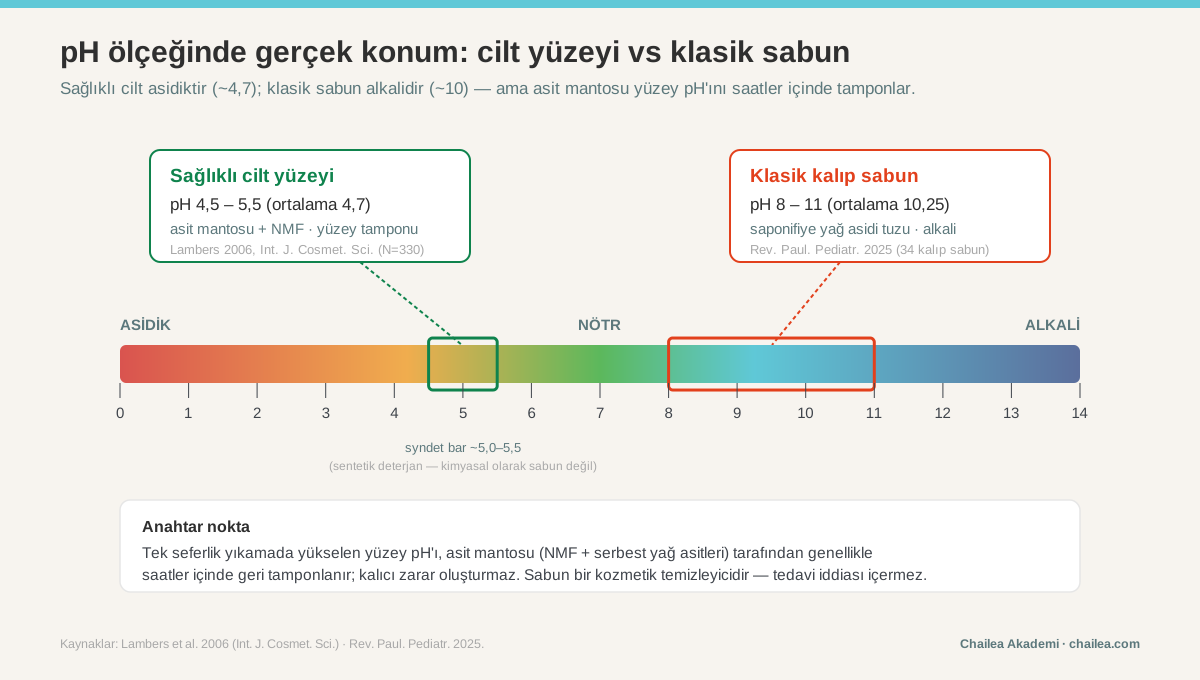
What is the skin's pH really? The acid mantle and why 4.7 (not 5.5)
Popular content repeats a fixed number: "skin pH is 5.5." This rounding does not match measurements from large patient cohorts. A study by Lambers and colleagues published in International Journal of Cosmetic Science (N=330) showed that human skin surface's natural pH is below 5—approximately 4.7. In the same study, forearm surface pH measured 5.12 when unwashed for 24 hours dropped to 4.93; that is, without cleanser contact, the surface finds a more acidic balance (Lambers 2006, DOI: 10.1111/j.1467-2494.2006.00344.x, PMID: 18489300).
The "skin pH 5.5" rounding is not entirely wrong; however, surface pH varies by body site (face, axilla, forearm), age, and recent cleanser contact. The evidence summary: healthy adult skin's natural surface pH moves within a band of 4.5 to 5.5 and averages below 5.
What is the acid mantle and what does it do?
On the surface of the stratum corneum lies a thin film made of sweat, sebum, free fatty acids, cholesterol esters, and natural moisturizing factor (NMF). This film's acidic character is called the acid mantle. NMF content consists essentially of urocanic acid, pyrrolidone carboxylic acid (PCA), lactate, urea, and free amino acids; these both retain moisture and buffer surface pH in a narrow range (Schmid-Wendtner and Korting 2006, Skin Pharmacology and Physiology, DOI: 10.1159/000094670, PMID: 16864974).
The acidic surface pH is linked to two critical functions:
- Permeability barrier formation: Enzymes responsible for ceramide synthesis and lipid organization—beta-glucocerebrosidase, acid sphingomyelinase—achieve their highest activity at acidic pH. When surface pH rises, the efficiency of these enzymes declines; barrier repair slows.
- Antimicrobial defense: The skin's resident flora balance (particularly coagulase-negative staphylococci) is more stable at acidic surface; certain pathogens (e.g., Staphylococcus aureus strains) proliferate more easily on neutral-alkaline surfaces.
These two functions mean: "the acid mantle is not merely a cosmetic concept; it is the chemical surface layer of the skin's natural defense architecture."
Where does the common "skin pH 5.5" rounding come from?
There are two reasons: first, skin surface pH follows a gradient from surface to depth—approximately 4.5–5.5 at the surface, but neutral in the deeper epidermis. The "5.5" figure corresponds to a middle point in this gradient and becomes a practical labeling target for products. Second, "syndet" bars—synthetic cleansers (e.g., sodium cocoyl isethionate formulas)—are engineered to pH 5.0–5.5; "cleanser at skin pH" messaging stems from here.
The key point: 5.5 is a labeling target, not a universal average. What truly matters is how quickly the skin returns to natural pH after washing.
Why is soap alkaline? Saponification chemistry and the pH 9–10 reality
Classic soap, chemically, is a weak acid / strong base salt. This is a direct consequence of salt behavior from high school chemistry and grounds all discussion of soap pH in one fact: true soap is, inescapably, alkaline in aqueous solution.
Saponification: fat + NaOH/KOH → fatty acid salt + glycerin
In cold-process soap making, triglycerides (plant oils) react with sodium hydroxide (NaOH, for solid soap) or potassium hydroxide (KOH, for liquid/cream soap). The net reaction equation is straightforward:
Triglyceride + 3 NaOH → 3 Fatty acid sodium salt (soap) + Glycerin (glycerol)
The salt produced has an anion (e.g., sodium oleate in oleate) that is the conjugate base of a weak acid—oleic acid. When dissolved in water, the anion undergoes partial hydrolysis; OH⁻ ions accumulate in the medium, and pH rises above 7. The alkalinity of soap stems from this hydrolysis equilibrium; it is not an "additive" or "caustic residue."
Why can't "real soap" be pH 5.5 from chemistry?
A consumer reading a "pH 5.5 soap" label should know that the label definition is likely not soap but a synthetic detergent / syndet bar. These are typically formulated from sodium lauroyl isethionate, sodium cocoyl isethionate, sodium lauryl sulfoacetate, or disodium laureth sulfosuccinate; pH is adjusted to 5.0–5.5 using buffering agents. This is not deception; it is a different category. However, terminology confusion arises: true (classic, saponified) soap cannot be reduced to pH 5.5 by design—if reduced further, the molecule ceases to be a fatty acid salt.
Superfat and free alkali: how 3–6% extra fat buffers pH
In cold-process production, a common formulation decision is superfat—excess fat ratio. The recipe uses less alkali than the calculated stoichiometry so that some fats remain unreacted, leaving behind free fatty acid (unrefined fat). These free fatty acids serve two roles:
- They buffer trace amounts of free alkali; this lowers finished soap pH from its upper limit (~11) into the 9–10 band.
- They impart a conditioning feel; moisturize while slightly reducing lather.
In workshop practice, superfat ratio is adjusted from 3% to 8% depending on fat profile and target skin feel. Formulas that feel "harsh" typically have low superfat (below 2%) or a high lauric/myristic acid ratio; formulas that feel soft typically have high superfat with high oleic acid content. This balance is explored in greater detail in production guides comparing cold-process to hot-process.
The fundamentals of saponification and free alkali assessment are documented in applied soap-making resources as well (Classic Bells—Superfat technical notes).
Measured real pH values: soap, syndet, and skin side by side
The biggest source of confusion in TR search results is which number is correct. The table below brings independent peer-reviewed measurements and skin surface value into a single view.
| Surface / product category | Measured pH range | Mean | Source |
|---|---|---|---|
| Healthy adult skin surface (unwashed) | ~4.5 – 5.5 | 4.7 | Lambers 2006, IJCS (N=330) |
| Classic bar (saponified) soap | 8.01 – 11.01 | 10.25 | Rev Paul Pediatr 2025 (34 bar soaps; 96-product study) |
| Classic bar soap (independent measurement) | majority 7 – 9 | — | Tyebkhan 2001, IJDVL (Indian market) |
| Liquid soaps | 4.54 – 8.08 | — | Rev Paul Pediatr 2025 |
| Syndet (synthetic detergent bar) | 4.99 – 7.78 | 6.00 | Rev Paul Pediatr 2025 |
Reading the table correctly: the answer to "what is soap pH?" is not a single number but a range dependent on category. Classic saponified bar soap is unavoidably alkaline (8–11 band) by chemical necessity. Syndet bars, as a category, lie closest to skin surface pH. Liquid soaps vary widely depending on buffer choice and surfactant selection.
In Tyebkhan's 2001 IJDVL study on the Indian market, most ordinary bar soaps measured pH 7–9; only three products (Dove, Aquaderm, Cetaphil) registered ~pH 6. Those three are either a typical syndet bar or a combo bar—meaning that "soap" shelf products as a category are alkaline by independent measurement across two different markets and time periods.
A cold-cured (rested 4–6 weeks) classic soap made by cold-process typically exits at pH 9 to 10. A pH of 11 or higher signals unreacted free alkali (caustic) and is unacceptable from a workshop quality-control perspective; such a batch is re-saponified or discarded. This is a measurable marker of producer responsibility.
The real question: Is alkaline soap actually harmful to skin? What does the evidence say?
That soap is alkaline as a category fact is settled. "Is it harmful?" is answered by asking how long alkalinity persists on skin and how the skin buffers it.
What happens to skin pH after washing?
The newest and most direct answer comes from a double-blind in vivo study published in Cosmetics (MDPI) in 2025 (41 adult volunteers; cold-process and hot-process natural soap washing with pre-wash, 2-min, 15-min, and 30-min measurements). Findings:
- Both cold-process and hot-process soap caused a statistically significant rise in skin surface pH immediately after washing.
- The measured elevation was tracked through the study's final time point, 30 minutes; the trajectory beyond 30 minutes was not measured in this study.
- Hot-process soap kept surface pH elevated longer than cold-process—meaning that over the same contact duration, alkalinity effect was more pronounced.
(Cosmetics 2025, 12(3):120 — Evaluating Skin Acid–Base Balance After Application of Cold-Processed and Hot-Processed Natural Soaps.)
This finding matters because it measures the magnitude and early half-hour trajectory of the "soap raises skin pH" claim in a clear time series. Older reviews mention "approximately 3 units rise per wash"; on healthy skin, this rise is transient, not permanent.
How long does skin pH take to recover? Buffering capacity and return
Skin surface's buffer capacity is fed from four sources: epidermal lipids (ceramides, free fatty acids, cholesterol), NMF components (especially urocanic acid and PCA, both functioning as weak acid/base buffer pairs), keratin's amino acid side chains, and ions from sweat and sebum. This integrated system, in healthy adult skin, allows post-wash surface pH elevation to typically return to its natural range within hours (Acid mantle review, IJDVL).
Two clarifying notes:
- "Within hours" is a range; a single face wash typically sees surface pH buffered within the first few hours. Repeated, intense, and prolonged washing (e.g., occupational frequent hand washing) extends this and can cumulatively strain the barrier.
- Return is not "healing"; it is normal skin physiology. This is why a single soap wash does not "damage" the skin.
Net frame: On generally healthy skin, washing with an alkaline soap does not cause permanent damage due to buffering mechanisms. The question is cumulative load: frequency, contact duration, current barrier status, and product choice together matter.
For whom is frequency and choice critical?
Under specific conditions, the acid mantle's buffer capacity shrinks; in these cases, soap choice and wash frequency become more important. From a cosmetic perspective—not medical advice:
- Dry or very dry skin: Lipid content is lower; skin's recovery time after alkaline cleanser contact lengthens. High-superfat, high-oleic / high-linoleic-acid cold-process soap or mild syndet formulas may be preferred.
- Sensitive skin: Barrier function is already limited; hot water and frequent washing are avoided.
- Compromised barrier skin (e.g., prolonged synthetic detergent, harsh climate, occupational exposure): Wash frequency is reduced; high-superfat, skin-conditioning formulas are preferred.
- Healthy adult skin: Twice-daily use of classic bar soap is well-tolerated due to healthy buffer capacity. Climate, season, and individual skin feel should still be monitored.
When skin disease is present (eczema, atopic dermatitis, rosacea, seborrheic dermatitis, etc.), cleanser selection is part of a physician/dermatologist evaluation; this text is a cosmetic information note, not medical guidance.
Does a "pH 5.5" label automatically mean "skin-friendly"?
A common simplification in advertising is the assumption that a cleanser labeled "pH 5.5" is automatically and directly gentle. Hawkins and colleagues tested this directly in a 2021 International Journal of Cosmetic Science study: a neutral pH syndet bar, when compared to two other pH-5.5 syndet products, was found to be gentler (Hawkins 2021, IJCS, DOI: 10.1111/ics.12721).
The implication: pH can be a gentleness signal but is not the sole determinant. The real driver of gentleness is the surfactant's structure, its concentration, and how it interacts with skin protein—especially corneocyte proteins. Sodium lauryl sulfate (SLS), even formulated "at skin pH" (~5.5), can swell corneocyte proteins and stress surface integrity. Conversely, a carefully formulated neutral or mildly alkaline composition might show lower protein disruption.
"pH 5.5" is a practical decision criterion; it does not guarantee gentleness on its own. This nuance is almost entirely absent from popular TR search results.
Cold-process soap's wash feel: glycerin and superfat
The glycerin (glycerol) byproduct of saponification stays in the cold-process soap matrix and is a potent humectant, contributing to the "slippery, moist feel" during washing. Combined with high superfat content, this feel can balance the transient pH rise that alkaline soap leaves post-wash from a dryness perspective—but surface pH still rises temporarily; it is the acid mantle's buffering, not glycerin, that returns it to the natural range.
Workshop note: Chailea formulas keep superfat ratio in the 3–6% band based on fat profile; this is chosen both to safely buffer free alkali and to avoid harsh wash feel. Production workflow and cure process details are covered in guides explaining what natural soap is and in INCI reading guides.
Frequently Asked Questions
Is soap's pH value harmful to skin?
Short answer: Not on generally healthy adult skin. Classic bar soaps are alkaline by chemical necessity (typical pH 8–11). Post-wash skin surface pH rises; however, the acid mantle's buffer mechanism (lipids, NMF, urocanic acid, PCA, keratin) returns surface pH to its natural range typically within hours. Single use causes no permanent damage. On dry, sensitive, or compromised-barrier skin, cleanser choice and wash frequency grow more important.
What is the pH of natural/handmade soap?
Cold-cured (4–6 week rest) classic soap made by cold-process typically comes in at pH 9 to 10. Superfat ratio (roughly 3–6%) and cure time buffer free alkali, holding pH in this range. A measurement of pH 11 or higher signals unreacted free alkali and is unacceptable from workshop quality control and should be reprocessed or discarded.
Can a real soap be pH 5.5?
No. Classic (saponified) soap is, chemically, a weak acid / strong base salt; it is unavoidably alkaline in aqueous solution. A product labeled "soap" at pH 5.5 is, chemically, a synthetic detergent / syndet bar—formulated with sodium cocoyl isethionate, sodium lauroyl methyl isethionate, or similar surfactants, with pH adjusted to 5.0–5.5 using buffering agents. This is a different product category; it is a chemistry difference beyond labeling.
How long does skin pH take to return to normal after soap?
On healthy adult skin, surface pH typically returns to its natural range (roughly 4.5–5.5) within a few hours post-wash. The buffering system responsible for this return consists of: epidermal lipids, NMF components (urocanic acid, PCA, lactate, urea), keratin amino acid side chains, and ions from sweat and sebum. Repeated, prolonged, and intense washing extends this timeline and can cumulatively strain the barrier.
Does every "pH 5.5" cleanser automatically mean gentler?
No. A 2021 IJCS study by Hawkins and colleagues showed that a neutral-pH syndet bar could be gentler than two pH-5.5 syndet competitors. The real gentleness driver is surfactant structure, concentration, and skin protein interaction—not pH alone. pH is a useful decision point but does not guarantee gentleness by itself.
Which soap has the "best" pH?
There is no single "best pH"—because pH is not gentleness in isolation. Decision criteria are evaluated together: skin's buffer capacity (dry / sensitive / compromised barrier?), wash frequency, formulation's surfactant profile, superfat ratio, and conditioning agents. For healthy adult skin, a cold-cured classic natural soap (pH ~9–10) with 3–6% superfat or a properly formulated syndet bar (pH ~5.5–6) are reasonable choices; individual skin feel determines the product.
References
- Lambers H, Piessens S, Bloem A, Pronk H, Finkel P. Natural skin surface pH is on average below 5, which is beneficial for its resident flora. International Journal of Cosmetic Science, 2006. DOI: 10.1111/j.1467-2494.2006.00344.x. PMID: 18489300. Link.
- Schmid-Wendtner MH, Korting HC. The pH of the skin surface and its impact on the barrier function. Skin Pharmacology and Physiology, 2006. DOI: 10.1159/000094670. PMID: 16864974. Link.
- Evaluating Skin Acid–Base Balance After Application of Cold-Processed and Hot-Processed Natural Soaps: A Double-Blind pH Monitoring Study. Cosmetics (MDPI), 2025, 12(3):120. Link.
- Children's soap pH analysis and its meaning in children's skin cleansing. Revista Paulista de Pediatria, 2025. DOI: 10.1590/1984-0462/2025/43/2025035. Link.
- Hawkins S, et al. Role of pH in skin cleansing. International Journal of Cosmetic Science, 2021, 43(4):474-483. DOI: 10.1111/ics.12721. Link.
- Tyebkhan G. A study on the pH of commonly used soaps/cleansers available in the Indian market. Indian Journal of Dermatology, Venereology and Leprology, 2001, 67(6):290-291. Link.
- Acid mantle: What we need to know. Indian Journal of Dermatology, Venereology and Leprology, 2021. Link.
- Classic Bells (Soapy Stuff) — Superfat and free alkali assessment notes (chemistry mechanism for practitioner reference). Link.