 pedia
This article approaches the topic not through brand messaging or personal experience, but through the triangle of hair fiber physics, pH chemistry and reactions in hard water. It makes no claim about treating any hair or skin disease.
Can you wash hair with bar soap? The collision of two pH values
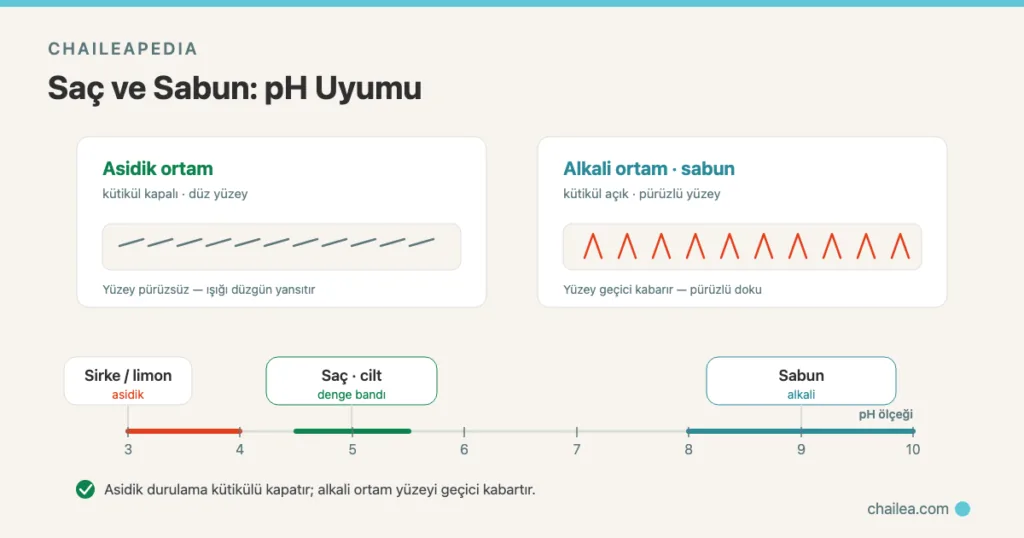
Can you wash hair with bar soap? Chemically, yes; bar soap cleans hair. However, the pH of soap (approximately 8–10) lies above the naturally acidic range of the hair shaft (4.5–5.5): the cuticle scales open, and in hard water a lime-soap residue remains. Whether the hair ends up soft rather than dull depends on the hardness of the water, the superfatting level of the soap, and a dilute vinegar rinse.
The hair shaft and scalp surface are naturally acidic. In the study by Lambers and colleagues of 330 participants, the average skin surface pH was found to be about 4.7, and it fell from 5.12 to 4.93 even after 24 hours without washing (Lambers 2006). This acidic "acid mantle" describes the natural chemical environment in which the scalp and hair shaft operate. A practical reference range for the hair shaft is roughly 4.5–5.5.
Classic bar soap, by contrast, consists of fatty acid salts and is typically clearly alkaline, with a pH of about 8–10. Given the starting materials of saponification (the conversion of fats into soap with KOH or NaOH), this alkaline character is unavoidable. The acidic world of the hair surface and the alkaline world of soap are therefore separated by at least 3 pH units, meaning a difference of roughly a thousand-fold in hydrogen ion concentration.
Gavazzoni Dias's comprehensive review explains clearly why this difference matters: cuticle scales lie flat and closed on the hair shaft in acidic conditions, while in alkaline conditions they lift and roughen the outer surface of the fiber (Gavazzoni Dias 2015). The question of whether hair can be washed with bar soap therefore depends on how the transition between these two pH zones is managed.
What happens to the cuticle in an alkaline environment?
The cuticle is the outermost layer of the hair shaft, made up of keratin scales overlapping in a roof-tile arrangement. The lie of these scales largely determines shine, slipperiness and combability.
Gavazzoni Dias et al. (Int J Trichology 2014) report that two measurable effects occur when hair is washed with products above pH 5.5: the surface of the fiber becomes more strongly negatively charged, and friction between fibers increases. The practical consequences of these two changes are frizz, tangling and a tendency toward breakage that increases with mechanical strain (Gavazzoni Dias 2014). The same study shows that a low-pH rinse or conditioner applied after an alkaline wash can neutralize the accumulated electrostatic charge and allow the cuticle scales to close again. The chemical logic of the vinegar rinse rests largely on this.
The proteomic dimension is supported by a more recent study. Adav and colleagues exposed hair strands to different pH environments and examined changes in cuticle structure and keratin proteins. The most pronounced protein damage and deamidation were recorded under strongly acidic conditions such as pH 3 and alkaline conditions above pH 8 (Adav 2025). This demonstrates two things at once: first, the soap pH range (~8–10) is more demanding for hair than a neutral or slightly acidic wash; second, pouring undiluted vinegar onto hair is equally risky. The logic that "more acidic is better" therefore does not hold.
The hard water factor: the chemical layer most articles overlook
The most critical difference in chemical behavior between bar soap and shampoos containing synthetic surfactants emerges in hard water. Understanding this distinction links the question "can you wash hair with bar soap?" to the water hardness variable.
The active compound of bar soap is a fatty acid salt. Sodium stearate (INCI: Sodium Stearate; PubChem CID 2724691, C₁₈H₃₅NaO₂, molecular weight 306.5 g/mol), for example, dissolves in water to yield stearate ions and sodium ions. When tap water contains sufficient calcium (Ca²⁺) or magnesium (Mg²⁺) ions, these two cations displace the sodium. The result is a water-insoluble salt: calcium distearate (PubChem CID 15324, C₃₆H₇₀CaO₄, molecular weight 607.0 g/mol).
In simplified chemical form:
2 C₁₇H₃₅COO⁻Na⁺ (in water) + Ca²⁺ → (C₁₇H₃₅COO)₂Ca (insoluble) + 2 Na⁺
This insoluble salt forms a thin film on the surface of the hair and scalp. The dull appearance, the sense of heaviness and the impression of "soap residue" encountered in practice are the direct result of this molecular transformation. The reason the film does not simply wash away with rinsing is not the size of the molecule, but that divalent calcium bridges two stearates and forms a water-insoluble salt, while the highly soluble sodium is removed from the system. The rise in molecular weight from 306.5 to 607.0 is the mass-based expression of this transformation.
Typical synthetic shampoos (sulfates, isethionates, glucosides and others) do not form such insoluble salts with Ca²⁺ and Mg²⁺, so "residue" behavior in hard water is markedly lower. The outcome of a bar soap routine therefore depends directly on the hardness of the water used. In regions with soft water, washing with bar soap is comparatively trouble-free; in areas with very hard water, an additional step is needed, and that step is most often an acidic rinse.
The discussion of water hardness and soap compatibility is directly tied to the chemical basis of the differences between bar soap and liquid soap.
The chemistry of the vinegar rinse: why it works and why it must be diluted
The widely held practice of a "vinegar rinse" is chemically simple but accurate. As its active component, vinegar contains acetic acid (PubChem CID 176, C₂H₄O₂, molecular weight 60.05 g/mol). Acetic acid is a weak carboxylic acid; in water it partially ionizes to yield acetate ions and hydronium ions.
A dilute solution prepared by adding one tablespoon of apple cider or white vinegar to a glass of water performs two chemical tasks:
- It lowers the pH of the environment. Excess hydroxide and the swelling effect left after the alkaline wash are calmed. Gavazzoni Dias 2014 reports that a low-pH rinse lays the cuticle scales flat again and neutralizes the electrostatic charge. Reduced frizz, increased shine and lower friction during combing are the direct results of this mechanical change.
- It interacts with the lime-soap residue. Acetic acid creates an acidic environment that increases the solubility of the calcium/magnesium stearate film deposited on the hair surface. Converted into more soluble forms, the residue is more easily removed by the rinse water.
When this study is read together with Adav 2025, the picture is complete: a strongly acidic environment near pH 3 damages hair keratin, though not as quickly as an alkaline one. This is why vinegar is not poured onto hair undiluted, but is diluted with water. As a practical ratio, one tablespoon of vinegar to a glass (~250 mL) of water yields a pH range that is acceptable for hair and can be rinsed out without leaving a sharp odor. The assumption that "more acidic is better" is chemically wrong; the goal is to neutralize the alkaline deviation, not to swing to the opposite extreme.
This logic of the vinegar rinse comes from the same chemistry textbook as the discussion of what soap pH means for skin; in both areas the principle is the same: alkaline cleansing, acidic return.
The layers are affected differently: cuticle and cortex are not the same thing
The hair fiber is not a single-layer structure. From outside inward there are the cuticle, cortex and medulla. The effect of pH is not uniform across these layers.
Velasco et al. (Int J Trichology 2022) showed that acidic and alkaline treatments leave differential effects on the cuticle and cortex. The mechanical properties of the cuticle and the structural integrity of the cortex are affected differently by the same process; alkaline conditions place a distinct mechanical load on the cortex-cuticle connection in particular (Velasco 2022).
This finding also serves as a reminder that the narrative of those who advocate a bar soap and dilute acidic rinse routine, namely that "the cuticle opens first and is then closed," is oversimplified. The cuticle can indeed be relaid, but if alkaline exposure is long and repeated, effects accumulated at the cortex level are not fully reversed by every rinse. For this reason, the soap and acidic rinse routine is better tolerated when the hair is generally healthy and has not been subjected to intensive physical treatment (frequent heat styling, coloring, bleaching).
Viewed alongside the approach that explains natural soap selection by skin type, there is no chemical answer that "suits everyone"; hair type, water hardness and the physical history of the hair fiber are the determining factors.
Practical framework: chemically possible, dependent on variables
Taken together, the picture reads as follows:
- Washing hair with bar soap is physicochemically possible; the soap dissolves oil and removes dirt and sweat residue from the surface.
- Three critical variables apply: the hardness of the water, the pH and fatty acid composition of the soap, and whether the final rinse step is acidic.
- A dilute acidic rinse such as vinegar can largely reverse the mechanical effect of alkaline washing on the cuticle; however, it must be diluted.
- Chemically treated hair (colored, bleached, straightened) tolerates alkaline washing less well.
The scientific answer to the question "Can you wash hair with bar soap?" is therefore: "Yes, but it depends on variables." That experiences differ from person to person is not a coincidence, but the result of different combinations of these three variables.
Application advice (usage instructions):
- Lather the soap first in your hands and apply the foam, rather than rubbing the bar directly along the fiber on wet hair.
- After washing, do the final rinse with a dilute solution prepared at a ratio of one tablespoon of vinegar to a glass of water.
- Leave the acidic rinse on for one minute, then rinse gently with water; the sharp smell is volatile and does not remain once the hair dries.
- In hard water areas, where tolerance is lower, reducing washing frequency or performing an additional rinse is a reasonable adjustment.
Frequently asked questions
Can you wash hair with liquid soap?
Yes; true liquid soap (vegetable oil saponified with potassium hydroxide) cleanses hair, but it carries the same alkaline chemistry as bar soap (pH around 9): cuticle opening and hard-water residue also appear here. Most "liquid hand soaps," however, are not soap at all but mixtures of synthetic surfactants designed for purposes other than hair.
Can you wash hair with hand soap?
"Hand soap" covers two different products. Bar-form hand soaps are mostly genuine soap: they clean hair, but are alkaline and need a dilute vinegar rinse. Most pump-dispensed liquid hand soaps, on the other hand, are syndet (synthetic detergent) mixtures; they are not designed for the scalp and do not replace shampoo.
Is washing hair with soap harmful?
Calling it simply "harmful" is not the right frame. The pH of soap (~8–10) is far from the acidic range of the hair surface and lifts the cuticle scales (Gavazzoni Dias 2014); a dilute acidic rinse can reverse much of this effect. Treated (colored, bleached) hair tolerates repeated alkaline exposure less well (Velasco 2022).
What vinegar ratio should be used, and can it be poured directly?
It should not be poured directly. One tablespoon of vinegar in a glass (~250 mL) of water maintains a reasonable acidic range for hair; damage to hair keratin has been reported in highly acidic environments near pH 3 (Adav 2025). The difference between apple cider vinegar and white vinegar is small in terms of acetic acid concentration.
Why does soap make hair dull in hard water?
Calcium ions in hard water displace the sodium of sodium stearate, forming insoluble calcium distearate. This salt leaves a thin film on the hair surface, and dullness and a feeling of heaviness are the result of this film. Synthetic shampoos do not form such a salt. A dilute acidic rinse increases the solubility of the film and thereby reduces its effect.
References
- Lambers H, Piessens S, Bloem A, Pronk H, Finkel P. Natural skin surface pH is on average below 5, which is beneficial for its resident flora. Int J Cosmet Sci. 2006;28(5):359-370. DOI:10.1111/j.1467-2494.2006.00344.x (PMID 18489300).
- Gavazzoni Dias MF, de Almeida AM, Cecato PM, Adriano AR, Pichler J. The Shampoo pH can Affect the Hair: Myth or Reality? Int J Trichology. 2014;6(3):95-99. DOI:10.4103/0974-7753.139078 (PMID 25210332; PMCID PMC4158629).
- Gavazzoni Dias MF. Hair cosmetics: an overview. Int J Trichology. 2015;7(1):2-15. DOI:10.4103/0974-7753.153450 (PMCID PMC4387693).
- Velasco MVR, de Sá-Dias TC, Dario MF, Bedin V, Fileto MB, de Oliveira AC, Pinto CASO, Baby AR. Impact of Acid ("Progressive Brush") and Alkaline Straightening on the Hair Fiber: Differential Effects on the Cuticle and Cortex Properties. Int J Trichology. 2022;14(6):197-203. DOI:10.4103/ijt.ijt_158_20 (PMID 37034547; PMCID PMC10075350).
- Adav SS, Wu ARYL, Ng KW. Insights into structural and proteomic alterations related to pH-induced changes and protein deamidation in hair. Int J Cosmet Sci. 2025;47(2):281-296. DOI:10.1111/ics.13029 (PMID 39529213; online 11 November 2024).
- PubChem (NIH) compound records: Acetic acid CID 176 (C₂H₄O₂, 60.05 g/mol); Stearic acid CID 5281 (C₁₈H₃₆O₂, 284.5 g/mol); Sodium stearate CID 2724691 (C₁₈H₃₅NaO₂, 306.5 g/mol); Calcium distearate CID 15324 (C₃₆H₇₀CaO₄, 607.0 g/mol).